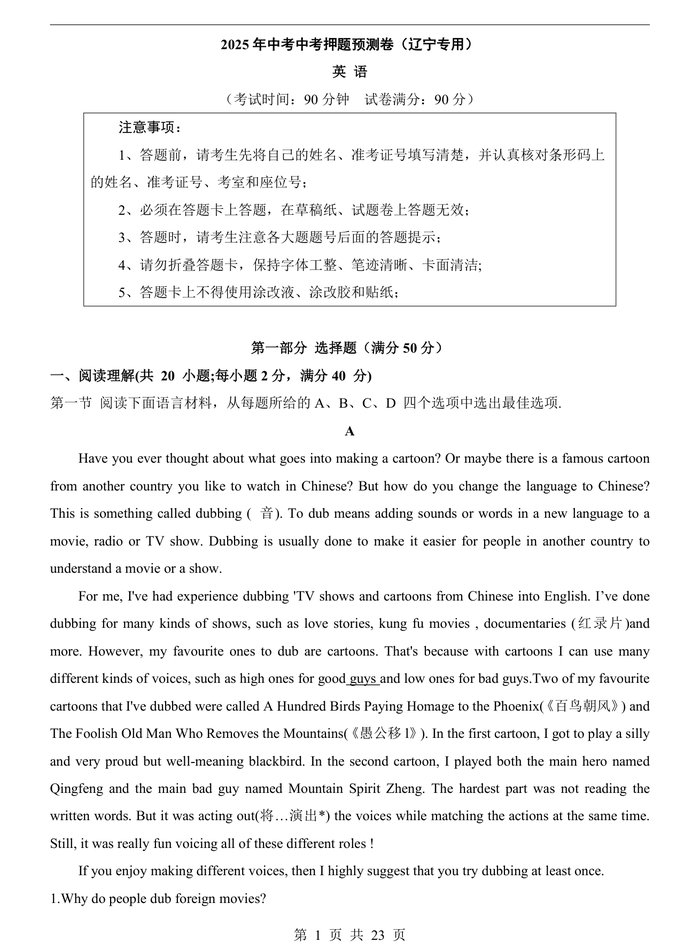
A. To make the movies easy to understand.
C. To show their foreign language skill.
B. To increase the movies’ ticket prices.
D. To add their own opinions in the movies.
2. "The underlined word "guys" in paragraph 2 means ________in the text.
A. roles B. voices
C. stories
D. lifestyles
3. What did the writer dub in A hundred Birds Paying Homage to the Phoenix?
A. A child. B. A bird.
C. A mountain spirit.
D. An old man.
4. What was the hardest part for the writer in dubbing the second cartoon?
A. Dubbing the voice of a blackbird.
C. Reading aloud behind the screen.
B. Writing the words for the movies
D. Matching voices and actions well.
B
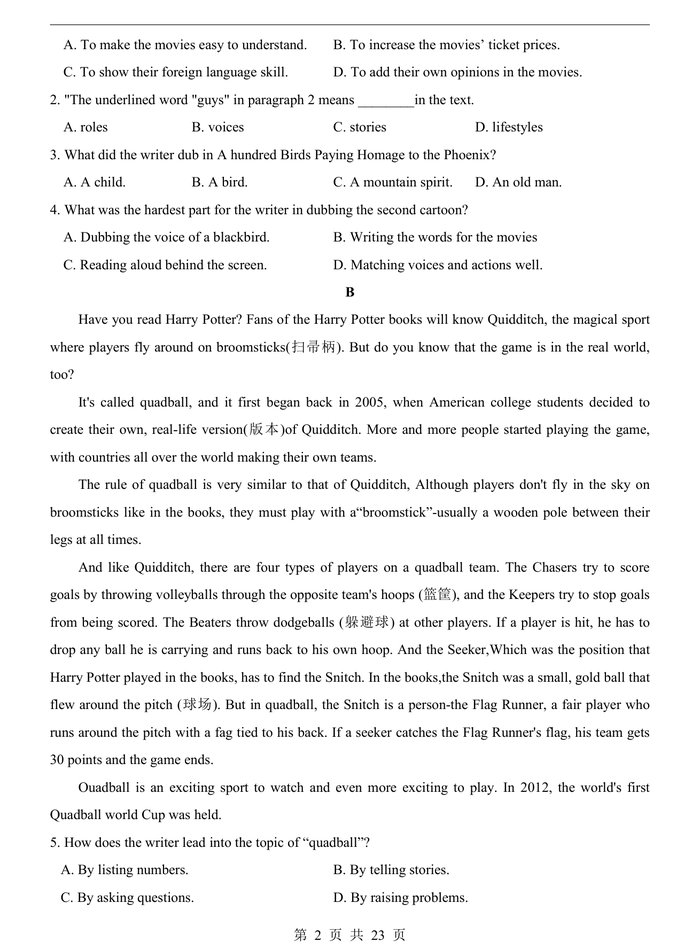
Have you read Harry Potter? Fans of the Harry Potter books will know Quidditch, the magical sport
where players fly around on broomsticks(扫帚柄). But do you know that the game is in the real world,
too?
It's called quadball, and it first began back in 2005, when American college students decided to
create their own, real-life version(版本)of Quidditch. More and more people started playing the game,
with countries all over the world making their own teams.
The rule of quadball is very similar to that of Quidditch, Although players don't fly in the sky on
broomsticks like in the books, they must play with a“broomstick”-usually a wooden pole between their
legs at all times.
And like Quidditch, there are four types of players on a quadball team. The Chasers try to score
goals by throwing volleyballs through the opposite team's hoops (篮筐), and the Keepers try to stop goals
from being scored. The Beaters throw dodgeballs (躲避球) at other players. If a player is hit, he has to
drop any ball he is carrying and runs back to his own hoop. And the Seeker,Which was the position that
Harry Potter played in the books, has to find the Snitch. In the books,the Snitch was a small, gold ball that
flew around the pitch (球场). But in quadball, the Snitch is a person-the Flag Runner, a fair player who
runs around the pitch with a fag tied to his back. If a seeker catches the Flag Runner's flag, his team gets
30 points and the game ends.
Ouadball is an exciting sport to watch and even more exciting to play. In 2012, the world's first
Quadball world Cup was held.
5. How does the writer lead into the topic of “quadball”?
A. By listing numbers.
C. By asking questions.
B. By telling stories.
D. By raising problems.