02
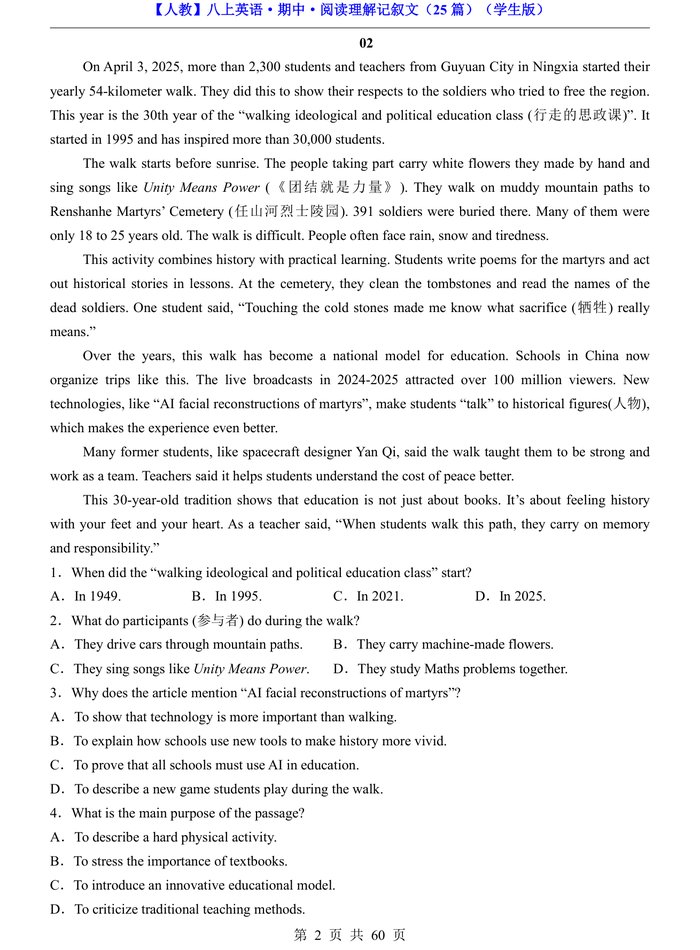
On April 3, 2025, more than 2,300 students and teachers from Guyuan City in Ningxia started their
yearly 54-kilometer walk. They did this to show their respects to the soldiers who tried to free the region.
This year is the 30th year of the “walking ideological and political education class (行走的思政课)”. It
started in 1995 and has inspired more than 30,000 students.
The walk starts before sunrise. The people taking part carry white flowers they made by hand and
sing songs like Unity Means Power (《团结就是力量》). They walk on muddy mountain paths to
Renshanhe Martyrs’ Cemetery (任山河烈士陵园). 391 soldiers were buried there. Many of them were
only 18 to 25 years old. The walk is difficult. People often face rain, snow and tiredness.
This activity combines history with practical learning. Students write poems for the martyrs and act
out historical stories in lessons. At the cemetery, they clean the tombstones and read the names of the
dead soldiers. One student said, “Touching the cold stones made me know what sacrifice (牺牲) really
means.”
Over the years, this walk has become a national model for education. Schools in China now
organize trips like this. The live broadcasts in 2024-2025 attracted over 100 million viewers. New
technologies, like “AI facial reconstructions of martyrs”, make students “talk” to historical figures(人物),
which makes the experience even better.
Many former students, like spacecraft designer Yan Qi, said the walk taught them to be strong and
work as a team. Teachers said it helps students understand the cost of peace better.
This 30-year-old tradition shows that education is not just about books. It’s about feeling history
with your feet and your heart. As a teacher said, “When students walk this path, they carry on memory
and responsibility.”
1.When did the “walking ideological and political education class” start?
A.In 1949.
B.In 1995. C.In 2021.
D.In 2025.
2.What do participants (参与者) do during the walk?
A.They drive cars through mountain paths.
C.They sing songs like Unity Means Power.
B.They carry machine-made flowers.
D.They study Maths problems together.
3.Why does the article mention “AI facial reconstructions of martyrs”?
A.To show that technology is more important than walking.
B.To explain how schools use new tools to make history more vivid.
C.To prove that all schools must use AI in education.
D.To describe a new game students play during the walk.
4.What is the main purpose of the passage?
A.To describe a hard physical activity.
B.To stress the importance of textbooks.
C.To introduce an innovative educational model.
D.To criticize traditional teaching methods.